Show Me Your Traffic, and I’ll Tell You Who You Are
The Airport Taxi Test
The immigration officer stamps your passport to check your legal right to enter. But the real entry test happens the moment you step outside the terminal and hail a taxi.
Before you speak the language, taste the food, or hold your first business meeting, you experience the traffic. It is the rawest, most unscripted data point a country has to offer.
We tend to think of traffic as an engineering problem. We see it as a matter of asphalt density and signal timing. But it is actually a psychological one. Traffic is the only environment where thousands of strangers interact in high-stakes, life-or-death situations, continuously, with zero introductions.
It is a massive, real-time negotiation of a society’s collective values. It reveals how we balance individual desire against the common good, how we view authority, and crucially how we work.
The Hardware vs The Software
Every country has the “Hardware” which includes the traffic laws, the painted lanes, and the red lights. But what actually governs the road is the “Software,” or the unwritten social norms.
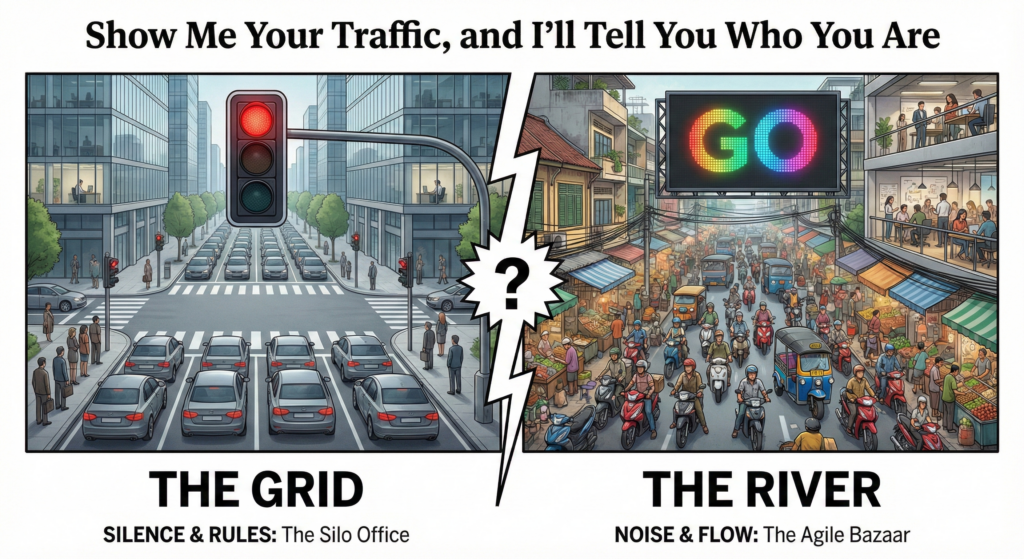
In Northern Europe, the “Hardware” is absolute. A red light in Germany or Switzerland is a moral command. To cross it at 3:00 AM, even when the street is empty, feels like a violation of social contract.
In Southeast Asia or parts of the Middle East, the “Software” overrides the Hardware. A red light is merely a suggestion. It serves as a piece of advice to “proceed with caution” or “yield if necessary.”
This disconnect is the first clue to a nation’s relationship with governance. If drivers ignore lane markings because “everyone else is doing it,” you are looking at a society where social consensus overrides official policy.
The Language of the Road
How drivers communicate on the road is a direct mirror of how they communicate in the office. This is most visible in the use of the horn.
1. The European Silence (The “Exception” Culture) In Europe, the road is silent. The horn is a weapon used only in emergencies or to punish (“What are you doing?!”).
- The Office Parallel: Silence is the default state of work. You work independently. You only send an email or call a meeting when something is wrong or needs specific approval. Communication is formal, structured, and sparse. To “honk” or send an urgent message is seen as aggressive.
2. The Asian/Middle Eastern Noise (The “Presence” Culture) In Vietnam or Egypt, the horn is a sonar signal. It simply means “I am here” or “I am beside you.” It is constant, informative, and devoid of anger.
- The Office Parallel: Noise is the default state of work. Silence is suspicious because if you aren’t communicating, are you even working? The “horn” translates to a constant stream of WhatsApp messages, Zalo groups, or quick desk drop-bys. It isn’t aggressive. It is a “ping” to show you are active and present in the flow.
Hierarchy and Equality
Traffic is the great equalizer, or at least it should be. But in many places, the road is a display of raw power dynamics.
The Size Rule: In many developing nations, the bus does not yield to the pedestrian. The bus owns the road simply because it is bigger. A luxury SUV in the Middle East might cut across three lanes while everyone brakes to let them in.
This is a physical manifestation of “Power Distance.”
- High Power Distance: The “big fish” (the boss, the wealthy, the SUV) expects the “small fish” (the employee, the motorbike) to adjust around them.
- Low Power Distance: In Scandinavia, a CEO in a Volvo waits for the same bicycle crossing as the intern. The rules apply to everyone equally.
From the Road to the Meeting Room
If you want to understand how a local team works, stop looking at their org chart and look at their commute. The behaviors are identical.
1. The Zipper Merge vs. Blocking the Box
- The Zipper Merge: This requires high trust. I let you in because I trust the system will keep moving.
- In the Meeting Room: This is cross-departmental collaboration. “I will give you resources now because I trust you will help me later.”
- Blocking the Box: This happens when a driver enters an intersection they cannot exit, gridlocking cross-traffic just to gain a few inches.
- In the Meeting Room: This is the “Silo” mentality. Managers hoard budget, talent, or information. They block the company’s flow to secure a tiny, short-term win for their own department.
2. Lane Discipline vs. The Flow
- Strict Lanes (Europe): You stay in your lane. You do not improvise.
- In the Meeting Room: “That’s not my job description.” Employees follow the process perfectly but may lack agility when a crisis hits.
- Fluid Flow (SEA): In the “river” of motorbikes, lanes are theoretical. You flow into any available gap.
- In the Meeting Room: “I saw a problem, so I fixed it.” Employees are agile and opportunistic. Titles matter less than getting the job done, but the organization can feel chaotic and hard to scale.
Chaos vs Flow
Ultimately, traffic divides the world into two philosophies: The Grid and The River.
- The Grid relies on predictability. Safety comes from everyone following the rules.
- The River relies on awareness. Safety comes from everyone paying attention to everyone else.
Neither is inherently “wrong,” but they represent fundamentally different ways of managing risk. One manages risk through control, and the other through adaptation.
The Asphalt Mirror
Traffic is the ultimate truth-teller because it is unscripted. You cannot fake a traffic jam.
When we complain about traffic, we are rarely complaining about cars. We are complaining about the collective personality of our neighbors. We are critiquing their aggression, their passivity, their selfishness, or their robotic adherence to rules.
So the next time you are stuck in a gridlock, look around. You aren’t just looking at a line of cars. You are watching a live simulation of the country’s soul. You are seeing how they negotiate, how they fight, and how they work.
Show me your traffic, and I’ll tell you who you are.
